
Rhea County Court Calendars Explained
The June 17, 2024 Twelfth Judicial District Local Rules are the strongest official source. They set Rhea County's recurring calendar. Grand jury dates appear there. So do criminal discussion, plea, motion, revocation, sentencing, and Chancery docket-call patterns. What they do not publish is a live, name-by-name Rhea County court calendar. The clerk posts no public daily calendar for General Sessions either.
Each setting lives inside its own court file. Circuit, Criminal, General Sessions, Chancery, Juvenile, and municipal courts keep separate calendars. They often use separate clerks. The newest docket entry, confirmed by the maintaining clerk, controls when a person must appear. A recurring rule date helps you understand how the court operates. It cannot replace direct confirmation in one case. Keep the clerk's confirmation alongside the most recent notice.
Rhea County Court Calendar Rhythm
The rules set the grand jury months. The Rhea County grand jury meets on the first Monday of February, April, June, August, October, and December. Bound-over matters, motions, revocations, and sentencings follow. They land on the Friday following each of those grand-jury months. Discussion Day falls on the second Thursday of every month. Plea and assignment days follow added month-by-month patterns.
| Calendar event | Recurring pattern | How to use it |
|---|---|---|
| Grand jury | First Monday in six even months | District context only |
| Discussion Day | Second Thursday monthly | Confirm the individual setting |
| Chancery docket call | First Thursday in June and December | Ask whether the case is on the call |
These rules organize court work; they are not proof a named case is set. A special setting, later order, or continuance can control instead.
Finding Your Court Date
The court offers no public Rhea County trial-court calendar search, so begin with the court and the exact case number. Circuit Court Clerk Jamie Holloway handles Circuit, Criminal, and General Sessions matters at 423-775-7818. Clerk and Master Bonnie Doss covers Chancery at 423-775-7806. The AOC clerk directory carries current contact details.
- Identify the court family from the notice.
- Use the exact case or citation number.
- Ask the clerk for the newest setting entry.
- Confirm date, time, courtroom, judge, and hearing type.
- Check again before travel after any reset.
At the counter, ask to see the public docket register and whether staff-assisted or terminal access is available. Written and mailed requests can produce copies. Courthouse postings and docket call on arrival help too, and counsel can confirm attorney notice. Municipal dates come from the issuing city clerk. Public Case History covers appeals only.
Rhea County Court Dates Need Confirmation
A recurring rule date is not a hearing notice for you. Special settings, continuances, and later orders can all intervene. They can shift the Rhea County court calendar. Search snippets go stale. Confirm the current entry by case number with the named clerk.
Myth: Every case of one type appears on the recurring day. Fact: The case docket and current court order control.
This distinction matters most for Chancery docket call and Criminal Court plea, motion, and sentencing calendars.
How to Read a Court Setting
Read a Rhea County setting one field at a time. Date and time tell you when the event is scheduled. Courtroom or division tells you where. The judge field names the judicial officer. Setting type states the purpose. Status text may read active, continued, reset, submitted, or completed. No single field proves an outcome.
| Date | The scheduled day, subject to a later order. |
|---|---|
| Time | Docket-call or individual-setting time. |
| Courtroom | The room, building, or division. |
| Judge | The judicial officer shown for the event. |
| Setting Type | Arraignment, status, motion, plea, trial, sentencing, or docket call. |
A setting means scheduled only. It does not show the event actually occurred. Read the later minute, order, judgment, or disposition for the result.
Rhea County Court Calendar Rooms
The Rhea County Justice Center opened in 2021 with three courtrooms, modern technology, separate public and secure circulation, and secure jail-to-court movement. Still, match a case to a room and court, not just to the building. The county's Justice Center description documents the facility and its features.
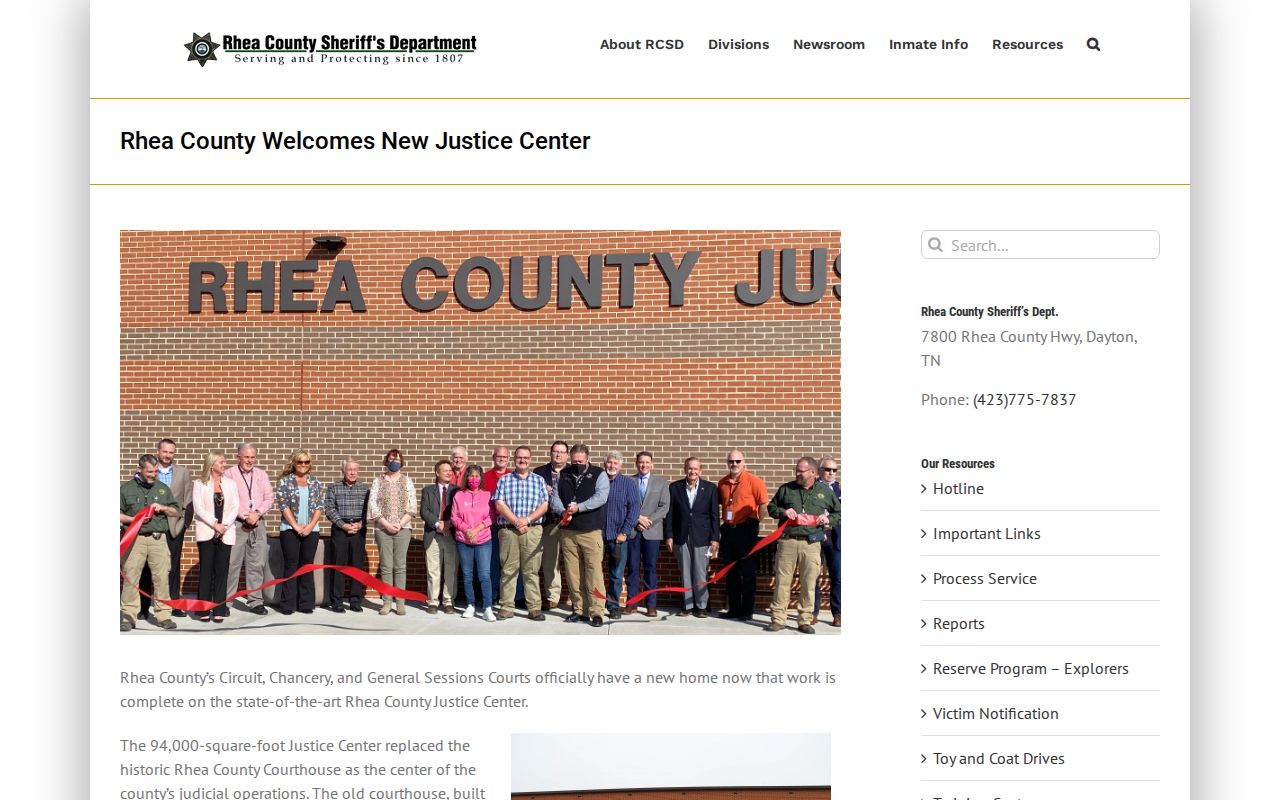
That page gives useful local facility context. The current docket supplies the actual courtroom assignment. Several court functions share the center while keeping distinct calendars. Confirm both room and court, especially when a matter moves from a preliminary phase to a later trial-court stage.
Continuances, Resets, and Cancellations
A continuance moves an event, and a reset assigns a new setting. A cancellation removes the listed event but may not end the case. The docket can show a motion first and an order later. Read both before assuming the calendar changed.
Check the newest entry, then call the clerk. Ask whether a written order exists. Ask whether the old date is inactive, and what replaces it. An appellate result may conflict with the local file. The maintaining court should resolve that discrepancy.
Note: A motion to continue does not change a setting. The court must act, or the clerk must confirm the change, before anything moves.
Attending Rhea County Court Dates
Confirm the courtroom, then allow time for the Justice Center checkpoint. The Sheriff's Office says entrants are subject to search. It bans guns, knives, and other sharp objects. Bring only needed papers and identification. Ask the clerk ahead of time about remote attendance or special document requirements. The courthouse security page lists the checkpoint rules. Jury questions should go to the court clerk. Use the current AOC number, since county directories carry inconsistent older labels.
One more thing: a municipal citation may belong at city court rather than the Justice Center. Confirm both location and court before travel.
If You Miss a Court Setting
Contact the maintaining clerk right away. Give the case number, court, missed date, and setting type. Ask what the docket now shows. Ask whether an order, warrant, default, dismissal, or new date was entered. The clerk can provide record information but cannot give legal advice.
Missed a setting? A failure to appear can prompt court action based on the case type.
Contact the Rhea County clerk or your attorney at once and obtain the newest entry.
Seek legal advice about how to respond before appearing without clear instructions.
Don't count on a new court date arriving by mail or showing up online. Rhea County posts no public live trial calendar. So confirm your next required step directly with the clerk. Keep any new notice or order, and check it against the docket entry. If the missed setting came from a city citation, call that city's court clerk instead of the county clerk.
Protected Rhea County Court Calendar Entries
Some settings never make it onto a public Rhea County court calendar. Juvenile matters may be left out or partly redacted. So may sealed files and entries tied to victims. Even so, a calendar paired with names can leak private context. Tennessee Supreme Court Rule 34 permits public access. But statutes, court orders, and privacy rules still control what the clerk can release. Seeing an adult docket does not give you that right. The same is true for a juvenile or protected entry.
When a date will not turn up, ask yourself a few questions first. Is the matter restricted? Could it be in municipal court, archived, or transferred? Or is it filed under a different case number? Then ask the clerk for whatever public or redacted portion exists. Do not chase a victim's address, a child's identity, or sealed material. Don't do it just to prove a proceeding exists.
A blank search result is not proof that no case or hearing exists. It often just reflects the limits of the channel you used. The clerk can still confirm a party's own setting through an approved method. That happens after verifying identity or authority. Keep the request narrow: the date, the court, and the instructions you need to appear. Keep sensitive names out of public notes, and hold onto only the scheduling facts.